Pages

.

Showing posts with label board game. Show all posts

St. George Board Game Convention


As the dog days of summer draw to a close, many of us are looking for something to do, especially if we have children who are becoming restless. It is hot the first part of August and may not seem like a good time to be in Southern Utah. But, the St. George Gaming Convention (STGCON) has created a fun get away for visitors and locals alike.

This year was the first time I was able to get to STGCON. The convention hosted its fourth annual event this year and I’m glad I got to be part of it. STGCON is a wonderful mix of board games that has a family friendly atmosphere.

Four Years Old

I sat with Alex, one of the founders, and talked with him about the history of STGCON. Five years ago there weren’t any gaming conventions in the area. The closest one to St. George was held in Salt Lake City. So, he and his wife thought they might do something about that by using their personal game library and start a convention.

They considered the first year successful with about 150 board gamers getting together. The next year they had around 200 people at the convention. This year they had 250. Not fast growth according to some. But, fast growth isn’t what Alex and his wife Shaea are looking for. They are happy with what it has done and the path it is on.

Part of the Gaming Room
The focus for STGCON has been to provide a quality family experience. This was visible at the convention, with the number of families and the age range of people. Families were enjoying games together and bringing in additional players. Alex told me that because of the size and the way it has grown, he knows just about everyone’s name attending.

What I Saw This Year

STGCON has a game library of over 1,300 different titles. These are not just old standards, Alex has actively grown the library; there were many newer games that could be experienced along with classics. I saw people playing games from the library which gave a family a chance to play something together, then as the children played one game, the parents might play something else.

Kids were running games for other kids. It was fun to see one young man running a tournament of 5-Minute Dungeon for 12 and under players. It looked like he was going to have to run more than one game to accommodate all those who gathered around his table.

1 of 3 Tables Getting Ready for a Tournament
His wasn’t the only tournament. There were enough events (tournaments, play to wins, and drawings) that there were probably enough prizes for just about everyone in attendance to take something extra home when everything was done.

Along with the mix in ages, there were people from around the region. According to pre-registration about 15% of the people were from St. George. I reacquainted myself with people I’ve met at other conventions along with making new friends.

Connecting with others is what STGCON is based on. I was invited to sit in on games by people who didn’t know me because there was an open seat. Kids joined together in games at one table as their parents joined in another game nearby. It was fun to see one pre-teen introduce her new friend to her mother and ask if they could go play a game at another table further off in the room.

The Future

A Heated Race of Pitch Car
STGCON is about the atmosphere and friendship. It is a place a family can go. Alex and Shaea want to keep it that way. They are not looking to force the convention into becoming larger, but are allowing it to grow at its own pace. They want a convention people want to come back to, which is what they have.

They are going to keep expanding their game library and continue working on making sure they have prizes to give away.

They want to keep the convention like St. George, accessible, friendly, and fun.

Alex did tell me that he would like to use the game library more often and one of the ideas they are looking at is making it available for the number of family gatherings that take place in St. George throughout the year. I suggest to anyone who may be having a gathering in or around St. George to contact them (STGCON website Facebook).

Summary

I enjoyed the day I was able to attend STGCON.

Check it out.

If you have a comment, suggestion, or critique please leave a comment here or send an email to guildmastergaming@gmail.com.

You can also join Guild Master Gaming on Google+, Facebook, and Twitter (@GuildMstrGmng).


reade more... Résuméabuiyad

SaltCon 2018 Panels You May Find Enjoyable


I'm looking forward to SaltCon this year (2018) because I've been invited to join in on panels about table top games—a topic I've been writing about for years. I'm sharing information about the panels because I know others are interested in the topics (because you’re reading an article about gaming), and, I am inviting you to join us. There are other panels you might find enjoyable at SaltCon's website, but I won't be on those (I may, however, be part of the audience because they look interesting to me).

This is going to be a fun four-day gaming weekend. But, I find games to be more than just fun; they are interesting, educational, social, and entertaining. Because I like games, I started Guild Master Publishing in the 1980s. It didn’t work out at the time. In 2012 Guild Master Gaming was started with a focus on writing. I still think it would be fun having my own gaming company, but I really enjoy writing and decided to pursue it instead of the other aspects of running a company.

My writing has allowed me to be more involved in the gaming and general geek community. Being on these panels I plan on sharing some of what I have learned from being around other writer/gamers (there are a lot of writers involved with regular gaming groups). I also hope to spark some creativity in anyone there to pursue their personal dreams of writing, publishing, and creating.

Panel 1: Greatest Board Games of All Time

A few of the games on my shelves
Dave Bailey (a SaltCon staple and gaming fanatic) asked me to sit on his panel discussing games. I am considering the history of gaming and how different games have evolved the gaming experience. Looking at some of the key games over time that have changed table top games.

So far there is no set agenda on the discussion and there will probably be some interesting insights from personal experiences we have had around a gaming table, or from what we do within the industry.

This discussion is scheduled at Saturday at 10 a.m.

Panel 2: Storytelling/World Construction in RPGs

I believe role playing games (RPGs) are about storytelling and creating a combined story. I know there are others who don't agree with me. For me a major part of the experience and the fun of an RPG is being in the story. And, an important part of a story is the setting, which gets us into world building.

World building can be creating something totally different or modifying the known.

I have written numerous articles and done some teaching about these topics. This topic for me is a little more personal because of the story aspect. Those who know me understand I like a good story and read a lot of them.

I will be with Derek Grey and David Morris (both of the Adventurers League). These guys are experienced RPG gamers with years of experience in creating and running games. If you have particular questions about running your own world, this should be a place to find some tricks and hints.

This discussion is scheduled for Saturday at 11 a.m.

Panel 3: Publishing RPGs, PDF or Printed

If you have wondered about how to get published, or how to publish your own work, come listen in to see if we can help you move in that direction you want to go. There are a lot of different directions a writer/creator can go in today's gaming world. And, there is more than one path to achieve your goals.

Robert J. Defendi and I are scheduled for this discussion. And if you haven't had the opportunity to read his work, or play one of his games, you have just been given a reading assignment.

This panel is scheduled for Saturday at noon.

Please come join us in the fun of these panels. Along with the fun the goal is to be interesting, educational, meet old friends, and make new friends.

If you have a comment, suggestion, or critique please leave a comment here or send an email to guildmastergaming@gmail.com.

You can also join Guild Master Gaming on Google+, Facebook, and Twitter (@GuildMstrGmng).


reade more... Résuméabuiyad

Forbidden Island, Game Review

Time is quickly running out as the land beneath your feet is sinking into the ocean. Your team of stalwart professional adventurers must work quick and smart to recover the treasures of the island and get everyone to the helicopter in time. You have experts on your team that can help in different ways, but even with all of your skill the island is going to be lost and this is the last chance to recover the artifacts of a time gone by.

Forbidden Islandis a cooperative game designed by Matt Leacock, illustrated by C.B. Canga, and distributed by Gamewright for 2 to 4 players where everyone succeeds together, or not. There are six characters that are randomly dealt to the players to determine who is working to recover the four artifacts. While the island is sinking players must work together to shore flooded areas and do the treasure hunting.

On your turn you draw cards from a players' deck. The players' deck consists of treasure, action, and Water Rise!" cards. Each player can only hold five cards in their hand, which creates another level of needing to work together. To recover a treasure you need a set of four of the same treasure card and there are only five of each in the players' deck. You have to decide which cards to save. Then when the opportunity arises you can pass treasure cards to get one player holding a set so they can move to the right tile and collect the treasure. After you complete your action island cards are drawn to see which sections of the island flood.

Drawing cards from the island deck creates the timer for the game and increases the difficulty the longer the game goes on. Similar to other cooperative games the island cards reset during play by the random draw of a Waters Rise! card from the players' deck. When this happens the previously played island cards are shuffled and placed on top of the island deck, putting any tile that have become flooded at risk of sinking out of the game. A water level chart also rises which determines how many island cards are drawn each turn.

Twenty four island tiles are placed in the same pattern to create the shape of the island, but they are placed in random order. Every game the island is different. There are two locations for each treasure and the helicopter pad. If the both treasure tiles for an unclaimed treasure sink or the helicopter pad sinks, the treasure hunters fail in their mission.

Forbidden Islandis for ages 10 and up. We played it several times and found it to have a good balance for older and younger players. The game is designed to last 30 minutes and we found that really close.

If you are a fan of Pandemicand have some younger players who want to join into the game, Forbidden Island is a game you should check into.

Originally published by Utah Geek Magazine.

If you have a comment, suggestion, or critique please leave a comment here or send an email to guildmastergaming@gmail.com.

You can also join Guild Master Gaming on Google+, Facebook, and Twitter (@GuildMstrGmng)


reade more... Résuméabuiyad

Conflicted: Surviving the Apocalypse--Game Review

You've seen the signs and you've prepared for society's collapse. When the time was right, you evacuated and established yourself on the outskirt of civilization. You were ready. You are ready. You will be ready.

Conflicted: Surviving the Apocalypse is a board game with the same theme as Conflicted: The Survival Card Game. Instead of the scenarios being read off the cards to be discussed in a party setting, Surviving the Apocalypse puts you in a more active role of building a camp, adding survivors, and working through conflicts with the government, other groups, and other players.

A friend and I had the opportunity to see the game at Salt Lake Gaming Con, but didn't have a chance to play it there. Instead, arrangements were made with one of the developers to play it at another time.

At the start of the game, each player has enough to build one camp: a place (Asset) to base yourself out of and a Leader. Along with those cards, you also receive Survivors and Equipment. You have to decide who goes into the camp and with what equipment. Each cards show the limitations and benefits they provide. It is important to build a camp strong enough that can defend itself. Since society is collapsing, others are after what you have, be it the Government, Attackers, or other players.

The Mechanics

The game uses different decks of cards to represent the different items mentioned above along with Chance, Death, and Disaster. During Each turn players gain two Chance cards. Other cards are collected by landing on a corresponding marker on the game board by moving around a lap, or by taking out other camps. You can only keep five cards in your hand, so it's important how you build and manage your camps.

The cards have a lot of information on them. For example, Assets can only support so many people, people can only use certain levels of equipment, and some equipment is used better by certain people. You need to keep an eye on what and who you have.

The End Game

There are multiple ways Conflicted: Surviving the Apocalypse can end. We decided we would end if one of three conditions were met: having four leaders in play (building four camps), removing four opposing leaders, or completing a lap on the board. Ours ended with four camps being established.

At the end, three of the four players were close to each other in what they were building. I was the fourth player, who wasn't really a threat to anyone else in the game.

Strategy Thoughts

Managing your cards during the building a camp phase determines how well you are defending your camp, and thus your camp's leader. You can also do this through negotiation with other players.

Bargains can be struck to help defend your camps, or attack others. There is no rule though about how you follow through. Conflicted is a game of opportunity, so to survive, and to come out on top, go after the opportunities when they present themselves.

Some of the random events almost have a reset value to the game. We were hit by a super volcano that took out all of the Assets, Survivors, and Equipment. We were left with only our Leaders that were in play.

Re-playability

There are enough cards that every game would be providing a different set of conditions to work with. In our game the developer (Shanna) mentioned it was the first time she was hit by a super volcano.

I wouldn't expect people playing back-to-back games since it takes between 1–2 hours, but you can expect it to be different each time you play.

The Look

Conflicted Games has gone with photographs to decorate the cards. This brings a different, more realistic feel to the game. Along with the pictures, the cards have additional statements that bring some light-heartedness into the game.

Overall

Conflicted: Surviving the Apocalypse is based on a disaster film on steroids. Society is collapsing and natural disasters can strike at any time. Along with the super volcano, our game was hit with a tsunami and a drought. Then, again, because of the randomness of the game, you could go an entire game without a disaster occurring. It is about surviving whatever happens.

We enjoyed the game. The developers are working out a few variations. However, the kinks observed were minor and easily worked out. Conflicted Games is taking their board game to Kickstarter soon and I am sure that by the time it releases, the game will be polished.

Conflicted: Surviving the Apocalypse is developed and distributed by Conflicted Games. It is designed for 2–6 players and no age was yet assigned.

Times are tough. Your crew is tougher. You are part of the few who have survived the apocalypse.

If you have a comment, suggestion, or critique please leave a comment here or send an email to guildmastergaming@gmail.com.


You can also join Guild Master Gaming on Google+, Facebook, and Twitter (@GuildMstrGmng).
reade more... Résuméabuiyad

Eschaton, Cult Strategy Deck Building Game, Game Review

The time of the Dark One's rising is getting closer. As Armageddon looms, the factions are striving to gain the glory of being the true followers. Building the cult by gaining worldly and other worldly followers. Looking for artifacts. Battling other cults. Preparing for the day of reckoning where one cult will be raised above the others to be the chosen of the Dark One.

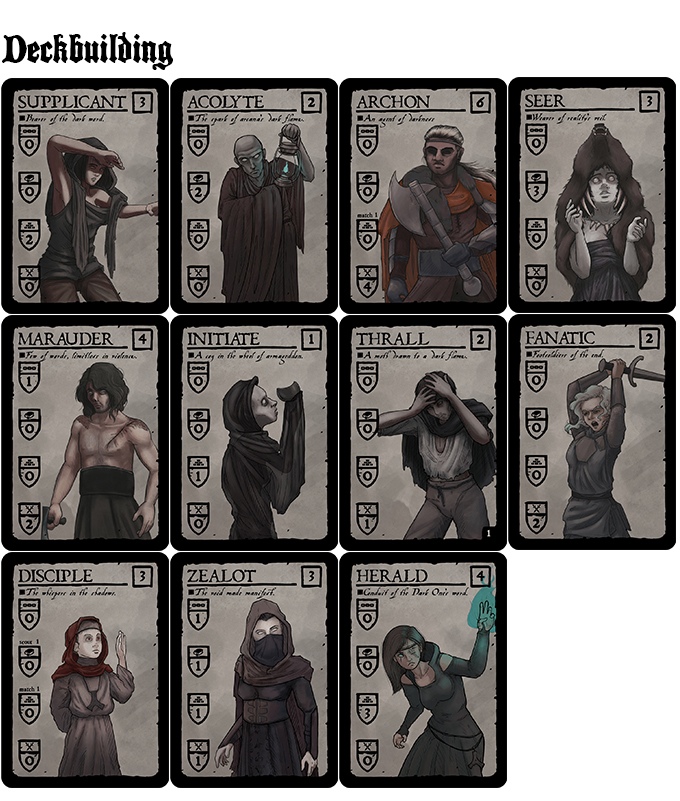
Eschaton is a deck building game, from Archon Games, pitting the players against each other in a dark fantasy world. Each player starts with a deck of seven cards and play a hand of five cards. Unlike some deck building games Eschaton does not rely on building connections between the cards. Instead, there are four attributes that different cult members represent. The hand is built, the scores for each attribute being played out in order.

Zeal allows the player to add more cards to their hand. No one starts with zeal. And certain cultist inspires more zeal in followers bring them out, in turn, making a player's hand bigger and adding to the scores of the attributes, if more zeal is added in the draw, then more cards are added.

Divination allows draws on the Arcana deck. This additional deck includes artifacts and other worldly followers that can be added to your deck. These build on your attributes, count for victory points, and affect play in other ways. In our game, my friend was able to add a card that every time it came into his hand he was able to curse another player, giving them a penalty.

Me taking some notes at the start of the game
Influence brings in more followers to your cult. The greater your influence the stronger the followers you can attract. This allows you to gain greater ability scores from a single card.

Aggression brings in the game board. The cults share the known world and it is through a player's aggression score that they are able to manipulate events on the board by adding and moving their own forces, or removing another person's markers from play.

Since the cards are score keeping your abilities, we found there is no reason to hide your cards when it becomes your turn. We started drawing the five and turning them over. This allowed for some quicker play because you weren't needing to look at the combinations that could be created. This was a great advantage also for learning the game.
A player can also shrink their deck. Along with building your deck you can sacrifice cultist and remove them from your deck. This is an interesting strategy that allows players to manipulate their deck to bring the stronger cultists into play more often by sacrificing the weaker ones needed earlier in the game. You don't have to sacrifice them and doing so doesn't count for or against any final scoring. It is a strategy move a player has to decide on doing to manage their deck.

The final deck used, the Event Deck, is the time keeper for the game. This is a semi-random deck that is built with Event and Omen cards. At the start of each round a card is turned over. Event cards effect play for that round. These can be random twists causing adjustments in strategy to cope with the event. Omen cards are longer term strategy changes that earns favor with the Dark One, victory points. Those stay in play until the next omen card, or Armageddon. Near the bottom of the deck, the Armageddon card announces the return of the Dark One, at the end of the round points are tallied and main cult is raised to glory while the rest are cast down.

Our game in progress
Two of us were able to sit down with one of the developers, Adam, to play Eschaton at Salt Lake Gaming Con this year (2017). The game was quick to learn and we were quickly into the full swing in the first round. Our event deck hit Armageddon on the seventh round, with two Omens going into play earlier. Our Seven round game went a few minutes over one hour. Our final scores were within seven points from high to low. And my friend came out on top of the developer.

Strategies

In our initial game three different strategies were being used. I was building world forces (aggression), my friend was building on divination, and the developer started out with zeal. As the game progressed I could tell there are other strategies that could be used. Strategies would also work differently with the number of players.

We had three players and there was limited contact on the game board. Eschaton is designed for up to 6 players, and the more there are the great the contact, and therefore, the aggression level. Strategy must take into consideration the number of people in the game.

Replay-ability

The variation in the artifacts deck and the event deck means that every game is going to have something different players have to deal with. Competition for the scoring from the Omen Cards will increase with more players. Personal decks will vary as different cards are added to reflect different strategies.

By changing the size of the Event Deck the length of the game can be varied, which will also impact strategy choices. We played 7 rounds, and the game definitely would have played out differently if we played with a deck that allowed for twice that number of turns.

Artwork

Some of the cards
The majority of art is done to match the theme of evil cultists. Most everything is done in black and white. However, the stronger cultists are done with more color, making it easier for them to be identified and advancing the feel of the theme presented. The art on the cards provides eye appeal during game play.

Overall

Eschaton is a good strategy game. It provides replay-ability and variations to the strategies used and how those strategies develop.

The setup and cleanup of Eschatonwas easy. The only constructed decks are the Event Deck and player decks. Cultist and markers are set out and the Divination Deck is shuffled.

The game is designed for ages 14+. I am sure this is because of the theme of the game. The rules were easy to learn and because you can play with an open hand on your turn, younger players can be helped without worry of over influencing their choices.

Eschaton is designed and produced by Archon Games (Web Page) (Facebook page)for 2–6 players, ages 14+. A game is designed to last 1–3 hours (and this is in controlled by how big you make the Event Deck).

Armageddon has arrived. Each cult bares themselves to the Dark One to see which one will be raised up. Fire blazes out consuming those judged unworthy while you and your fellow followers look on.

If you have a comment, suggestion, or critique please leave a comment here or send an email to guildmastergaming@gmail.com.

You can also join Guild Master Gaming on Google+, Facebook, and Twitter (@GuildMstrGmng).


reade more... Résuméabuiyad

Isle of Monsters, Game Review

The island is a peaceful place and the inhabitants like to keep it that way. They get few visitors because of the monsters that live on the island. Others wonder why the inhabitants stay on the island with such fearful monsters. But, they do, and, they don't seem to have any problems living with the horrid creatures.

Isle of Monsters, designed by Joshua DeBonis and Nikola Ristestki has artwork by Kwanchai Moriya and produced by Mayday Games, is about capturing monsters and caring for them so you can compete against the others players in scare contests.

Each player is working to become the Island Protector. This is done by catching and feeding the creatures on the island. Though the creatures look fierce and frightening, they are not. It is in how they are fed and presented that makes them look so ferocious.

Mechanics

There are several game mechanics taking place during the game. The first part of a round is spent gathering monsters and the food to feed them. Not all the monsters and food available on the game board are available to everyone, just those on the nearest outer islands and the center island. You need to keep an eye on what monsters your neighbor is feeding to see if there is the right food, and enough of it, for the monsters you have or want to capture.

After everyone passes from that phase the monsters that have eaten enough are matured and included into a deck used for the scoring phases of the round.

My hand early on
Scoring takes place in two levels. The first level is to present a single, or grouping of monsters of the same type (earth, fire, or water) to compete against the other players' monster(s) to scare the crowd in attendance at the Scare Festival. Individual monsters have scores from 1 to 9 and their scores are added together when they are played together. The card(s) are hidden so you don't know what others have chosen until everyone reveals at the same time. The person with the highest score on their cards wins the scare contest.

After the monsters have scared the crowd they can scare each other (fire scares earth, earth scares water, and water scares fire). This isn't worth as many points, but it is possible with a larger game that the person scaring other players earns more points than the person who won the contest.

The monsters used in that round of scaring are set aside and the next round starts with the players who have remaining cards. The scaring rounds continue until only one person, or none, has cards left in their hand. Additional scare points are earned for having extra monsters.

The monsters used in the scaring during the round do not leave the game, they just can only be used once a scare round. After the round they are returned to the deck the player is building. It is added to during the next maturing phase.

Strategy

Since each player is limited to the two piles of monsters on the outer islands to either side of them, strategy is limited to what is available. However, a player needs to be aware of the strength of the monster, higher points takes more food to mature, and what they eat. You also have to decide if you want to be able to combine monsters, therefore, they need to be the same type. You can also work at creating bigger or smaller monsters. (Early in the game there is not enough food to mature the bigger monsters.) Bigger monsters are better for winning the scare contests, but maturing more smaller monsters allows you to compete in more rounds.

Appearance

Some of the cards
During our play-testing it was the artwork that drew the attention of two of our players. The artwork is done by Kwanchai Moriya and one player mentioned that it reminded them of Pokemon cards. The artwork is fun and each of the monsters shows a different level of maturity for its type as it goes up in score.

The materials in the game are of good quality. The components are sturdy enough to withstand being played.

Re-playability

We were able to play a couple of games back to back without a problem. Younger players, or those who are not as adept at strategy, should be able to play this multiple times in a row without problems. It is also a game that could sit for a little while and be easily brought back to the table for another session.

Overall

Isle of Monsterswas easy to learn, and easy to teach. Set up and clean up was also quick. Although more experienced players have a slight advantage the advantage wasn't so much as to take away from the game.

Isle of Monstersis designed for 2–5 players. I played it with three players and it went well. There is a 2-player variation and I think the fun would increase as you add a fourth or fifth player.

Isle of Monstersis designed to last 20–45 minutes. Our games, even while learning took about 30 minutes. The time is controlled by the deck of monsters and the number of players doesn't vary the time much. The variable is more in deciding what you want to do.

Isle of Monstersis designed for ages 10+. Experienced younger players may be able to play this game. They may not catch all of the strategy nuances, but the artwork art is a draw for them.

A new Island Protector has been named. The others who vied for the title did well, it was a close competition. There is already talk of who is going to go for the title the next time the competition is held.

If you have a comment, suggestion, or critique please leave a comment here or send an email to guildmastergaming@gmail.com.

You can also join Guild Master Gaming on Google+, Facebook, and Twitter (@GuildMstrGmng).


reade more... Résuméabuiyad

Castle Panic, Game Review

Picture from Fireside Games
The castle stands and we as the defenders stand ready to defend it. There are hordes of monsters coming from all around us. We can work together to keep them from tearing down the walls and invading our home.

Castle Panic pits the defenders of the castle against the invading monsters. Players build a hand and play the cards allowing them to strike at the monsters in different zones. The goal is to keep them from getting to the castle walls. If they reach the walls, they can tear down them down and invade inside the wall.

I had the opportunity of playing Castle Panic at SaltCon in the room hosted by Double Exposure Inc./Envoy games. Three of us sat down and played the basic game with no expansions. The base game is a good for beginners and younger players. The expansions might also work, but I haven't played the game with expansions. The three of us were able to start quickly because the rules were straight forward and easy to understand. For two of us this was the first time we had played Castle Panic.

The board
We played a cooperative game. The instructor told us there were several ways to play, which included the cooperative style, team play of one side playing the monsters, solitaire, and one with players collect trophies for a high score. We went with the pure cooperative game, which I also found out was the first time one of our players had played a cooperative game.

The rules are easy to understand. Players start with a hand of cards that are used and traded to other players. Monsters are randomly drawn and placed on a zone of the board and they move forward to attack the castle. The cards give the player the opportunity of seeing which area they can defend and at what distance from the castle wall. There is some planning of seeing when an invader is within range and giving the right cards to that player who can make the defense.

Playing the cooperative game gave us an advantage of helping each other with advice on how to pass cards. Even the less experienced gamer at the table soon understood the basics and was picking up on the options they could do on their turn.

Moster tokens
Castle Panic is a good family game. It is rated for ages 10+, but younger players, especially those who have played some other games, can easily join in on their own. Inexperienced younger players may need a little help. The game also has a quick pace so the game keeps moving and keeps the interest of younger players. A friend with children told me this has become one of their staples on family game night. To add a more excitement, they use miniatures to represent the monsters attacking the castle.

Castle Panic is designed by Justin De Witt and distributed by Fireside Games. It is designed for 1–6 players to be played in less than an hour (our game took about 45 minutes).

If you have a comment, suggestion, or critique please leave a comment here or send an email to guildmastergaming@gmail.com.

You can also join Guild Master Gaming on Google+, Facebook, and Twitter (@GuildMstrGmng).


reade more... Résuméabuiyad