Pages

.

Showing posts with label painting. Show all posts

Current Projects - Autumn Gaming

This Autumn has been a great time, and a tough time, from the perspective of my hobby. I have had lots of time to spend writing reviews and working on articles and rules, and also some painting activities, but I haven't gamed since September, and had to miss Fall In.  Here is a rundown on the projects I have been working on...


I have been keeping up my research and work on the Once and Future Rules project, with upcoming reviews on Koenig Krieg and Angriffe, and some more ECW rules (Protz and 1644). Many others on the stack.

Writing an article that reviews and compares three different board games on the American Revolutionary War.

Finishing up my campaign rules (Lord of the Manor) for Chainmail. This was instigated by my recent review series.

Finishing up a set of Viking age skirmish rules ("By the Runes!").

Not much with RPGs right now.

Planning some Thanksgiving Weekend gaming (Frostgrave, Lion Rampant, and board games).

On the painting table, some things have been happening...

About two-thirds done with reorganizing and re-basing a large (2000+ figures) 15mm High Medieval collection.

Re-basing some Renaissance 15mm figures.

Reorganizing my AWI figures (maybe on hold for now...)

Building 15mm stone walls. Also planning to paint some Baueda 15mm wattle walls.

Painting some buildings (finishing desert buildings in 15mm, and starting some half timbered medieval buildings).

Prepping some 28mm medieval figures (from my dormant WotR project, now un-dormant).

Sorting out some crossbow figures in 15mm that can be either late Medieval, or Italian wars.  This will probably be my next 15mm paint project.

reade more... Résuméabuiyad

Horsing Around at the Painting Table

I recently received a shipment of 40mm x 30mm MDF bases, which means it is time to get caught up on some cavalry basing.

First up, 12 stands (36 figures) of armored 17th century cavalry.  These could be useful either as continental Cuirassiers in the Thirty Years War (or some time earlier).  Possible as Schwarzreiter during the Schmalkaldic War (maybe a little early for these figures, maybe not).  Also possible as Lobsters in ECW.


Next up, I have a unit that are clearly Reiters, from the look of their equipment and the plumed helmets.  As with the Cuirassiers above these fellows have 3/4 armor, black, and with pistols.  Different helmet styles, and slightly different armor styles are the big difference.


Moving away from the Renaissance (although not very far away), I also started re-basing my later Medieval Knights.  These fellows would fit right in during the late 14th or 15th centuries.  My inspiration?  I got these out to play a late medieval solo game of Chainmail (in honor of St. Crispin's Day), and was reminded of the basing situation.  That, with a new box of bases staring at me, told me to put off the solo game, and get the Knights re-based.  (as opposed to Chaucer, who would have them Debased).


This evening, I sorted out the first part of this collection, all of which need to be re-based.  In doing the sorting, I uncovered four basic categories of knights. 
  • There are knights (of different helmet designs) on chaffroned horses.  
  • There are knights on horses with just harness.  
  • There are knights on barded (metal barding) horses.  
  • And there are figures (knights?) who are carrying standards, musical instruments, etc - that could be part of these units.
I selected out the knights who were mounted on horses with just harness (and not full chaffron or  barding).  There were enough to do 14 stands of knights (3 figures per stand).  Those are who I based this evening (pictured above).  So why pull out the un-chaffroned knights?  Wargamers (and wargames army lists) love to differentiate.  Variety is the spice of life, after all.  In many army lists, there are second tier (or even third tier) Knights, representing either lower nobility, poor knights, mercenary heavy horse, etc.  These will be instantly identifiable on the table, as being different from the chaffroned knights, or the barded knights.  And there is still a lot of variety in pose, equipment, and armor style (probably too much variety in armor style - but I go to war with the army I have, rather than the army I want).

Finally, a few units I actually based a few nights ago.  These will see service in an upcoming 2nd Punic War game (at Fall In 2016).  Four Roman units, at three stands per unit.  These are in with my Late Republic Romans, but from looking at the equipment, and depending on the theater of operations, these could be (possibly) Pre-Marian, on up to maybe 1st century AD.  At least in 15mm scale, that is my claim. (the High Medieval knights are in the background).


 All this in addition to work I've done lately on my 16th century infantry (Swiss, German, and Spaniards).  In a day or two when the glue is set, I will flock the bases on all those above, and they will be off to fight in Flanders. Or Burgundy. Or Gaul.  Or Saxony.  Or Lincoln.  Or maybe just stay here in Stafford.

Pax. 

reade more... Résuméabuiyad

Recent Miniatures Projects

At GwC headquarters, recently there has been a lot of work going on at my miniatures workbench.  I have been painting and rebasing large quantities of my 15mm collection, and have started painting on some 28mm projects.

First, starting really before Christmas, and only finishing sometime during the winter convention season (re: MarsCon and Williamsburg Muster), I had rebased and flocked my Mexican American War collection.  This amounted to about 2000 miniatures, mostly infantry (although a decent amount of Mexican cavalry), rebased from cardboard and balsawood onto MDF bases, of the variety I usually purchase from resellers like GaleForce9 at wargames shows.  I have, in a manner very similar to many of my other 15mm age of rifles armies, based the infantry on 25mm square stands, with three miniatures per stand, and the cavalry on 30mm square stands, with two miniatures per stand.  The guns are on 40mm bases, with crew.  I have not hosted a game (solo or otherwise) with this collection yet, although this rebasing project is complete, because I needed to finish up some suitable terrain in 15mm.  All my adobe/desert style terrain is in 28mm for The Sword and the Flame, and most of it has a distinct middle eastern flavor (some could swing to Mexico or California, but not all).

Second, I had interrupted my projects with a really satisfying game of Renaissance, using the Neil Thomas rules, and my figures for the Italian Wars (covered in this blog here and here).  A very satisfying game, but at the time I did not do anything to rebase that collection of Renaissance figures.  That could be a project in the future, and would make them compatible with other figures that I have for the period.

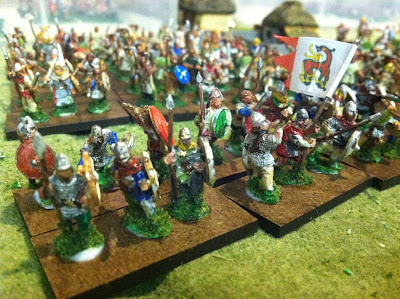
Third, I have begun a large project of rebasing and organizing my Dark Ages figures.  This is chiefly figures for four armies - Vikings (very large collection), Saxons, Normans, Welsh and Irish - recently added to my collection.  This allows a large variety of different battles and campaigns to be waged, but it also adds to an already decent sized collection of Vikings and Western Franks (Normans) that I had already owned.  Again, the rebasing is an attempt to bring a uniformity to the combined collection, and because I really prefer my own mix of flocking and MDF bases.  Here are a couple of pictures of figures from the new addition to the collection, in process (recently glued to the new bases, but not flocked yet).
New figures based - old bases on the slingers at the top right
In the first picture (above) you can see about seven units of figures, assuming 6 bases per unit.  Some of the units in the collection are this size, some larger, but it is very flexible, as there is very little to differentiate units, except for armament and some national characteristics in shield design, clothing, etc.  For instance, the three units in the upper left could be used for just about anything (Irish Bonnachts, Welsh, Saxon Great Fyrd), but were included with the Irish figures.  The presence of a priest and some of the banner designs indicate a Christian nationality.  On the other hand, the figures in the other units of the picture could just as handily serve as either Saxons or Vikings.  And considering, for instance at some of Brian Boru's battles (such as Clontarf), there is little difference between the Vikings on either side of the battlefield, these could also serve in an Irish army.  Notably, the Welsh also employed Vikings in their ranks as well.

The buildings in the picture feature on their bases my own mix of flocking.  It is made from a mixture of two different colors/grades of woodland scenic turf, and then has some small amounts of foliage mixed in, and some ballast to represent rocks.  I have been using a variant of that mixture since the late 1980s, off and on.

The old style of bases in the collection I recently acquired are pictured here, in the upper right of the picture.  It is a thin balsa style base, with a dark green grass used as flocking.  This is the same style that was employed in the Mexican American War collection, and also the Renaissance collection (they are from the same painter).  The style is good, and the look en masse is fine, it is just not what I prefer to use.  And rebasing gives me an excuse to spend time at the workbench, while listening to music and enjoying a pipe, so why not?  Below are some more pictures of the figures in progress.

[A word on the painting style - it is very different from my own.  These figures were painted with a white primer base under all the figures, and it leads to figures that have a very light look, overall, compared to my painting.  I will try to post some pictures of my own 15mm dark ages figures, in comparison, very soon.  I usually go for black primer, with white dry brush over it, and then paint in sold block colors, adding washes and detail last.  These seem to have a lot of wash style color areas added, which have a very good effect at a wargames table distance, and give a very colorful appearance to the army. It is just a different effect from my own figures.  I don't think the soldiers will mind, at all, being on the same battlefield, however.]

Very nice mixture of poses and manufacture - but I suspect a lot of Splintered Light

Closeup showing bases, wet glue(!) and figures.  Nice job on the banner!
I will be playing a solo game, very soon, as soon as the last of the Dark Ages figures are completed and off the gaming table (I rebase on the gaming table, and flock at the painting table - a sort of assembly line).

Considering that the theme for the Guns of August convention this summer is Medieval Battles, this collection should definitely be seeing some action at the convention.  I am considering a big multi-player Battleaxe-Blitz!  Details to follow, but think of a large many-factions Duke Siefried style game.  It seems proper.

In addition to the 15mm dark ages collection, I recently started painting some 28mm Foundry viking characters to use for SAGA and Lion Rampant as leaders.  Speaking of SAGA - this past year's Williamsburg Muster had some really great SAGA games going on, I really need to get an army finished up.  Here is a picture of Glenn from the Richmond Leisure Society, having a great time.


Great looking figures, Glenn.  I hope to put some of my own out there (I have a decent sized collection of older Ral Partha 25mm vikings, and such, but I really want to get my Foundry, Crusader and Old Glory figures painted - I have had them since Georgia, and keep putting them off).

I will most likely be missing Historicon this summer (although I do plan to be at RavenCon, playing some RPGs and boardgames, at the end of April).  The reason for that is because of my Daughter's schedule - summer camps and college preparation activities (she is in 11th grade, and deep in the process of picking a school for after she graduates).  Considering I have such a great time with her, it takes all the sting out of missing Historicon, but it means that I am deeply involved in getting prepared for Fall In as my next major (non-ODMS) convention.

Time with my daughter, the best reason to miss out on gaming conventions


In preparation for Fall In, I am working on two painting projects.  The first (to be detailed in a later blog entry) is 28mm Napoleonic British.  This will be my first Napoleonic project using plastic figures.  I am using the Warlord figures, and they are great to work with.  More details and pictures later.  The second project is getting ready for a Hail Caesar game.  This entails two things - getting my Early Imperial Roman figures rebased from individual mounts (used for Warhammer Ancient Battles) to group stands (4 men on a 40x40 base, for the formed infantry) that will be useful for a variety of different rules, including Hail Caesar (and still quite useful for WAB).  The second, and more exciting thing, is getting some Celtic units ready for a large Briton's army.  I am, again, using plastics for this (because I have the figures stockpiled already, and I have been *meaning* to get around to painting them for about 7 or 8 years now).  The first up are some Wargames Factory cavalry.  Here are some pictures of the figures I have assembled.  Yes, I know, I should have painted the riders and horses separate, but I really wanted to see what the assembled figures looked like, and I got carried away.  I think they look splendid!

Yes, you can see the gory details of the painting table, but the figures look absolutely splendid.  Can't wait to get paint on them.  Expect to see more pictures of them, once completed, here at Gaming with Chuck.

reade more... Résuméabuiyad

Why do I plan game activities?

To me, it is important to plan gaming activities.  This is because of a couple of different reasons, personally, so if I can ramble on for a few minutes, here are a few of them.

1. It gives me goals.  If I know I a want to do a game in the future (solo, for/with friends, at a convention) then planning will give me a timeline to get done what I need to (learn rules, paint miniatures, playtest, write up a dungeon, etc).  Of course, procrastination is always a stumbling stone, but with a plan, at least you can know what you SHOULD have done, on the way down, once you stumble.
 

2. Mental exercise.  Sometimes, my schedule is just too darned full to get in some of the gaming activities I want to do.  For instance, in my current look at 15mm AWI gaming, one thing I would like to do is rebase some miniatures.  Also build some terrain.  But I might not have good chunks of time in my schedule over the next few weeks to do those things - but what I can do is research battles, re-read rules, and maybe get orders of battle and scenarios down on paper.  Why those things?  Because they are all easily doable at the computer, or with a tablet, or with a book and pencil - while doing other things.  Lunch, watching a movie with the family, waiting for response on a work email.  etc.  They are planning activities - not the same as actual gaming activities - but they scratch an itch and keep my mind engaged in the topic.

3. Evaluate what needs to be done for a future event.  If I plan to do a Third Crusade wargame in November (which I am thinking of), then I will start thinking about my miniatures, rules, wargames terrain, scenario - etc.   While planning, I will take stock of what I already have available, and what needs to be developed.

4. Sometimes if I don't plan things, then (since I am interested in so many different gaming topics, and a victim of my own ability to change focus at the drop of the hat) sometimes I don't get anything done, and another year has passed and I still haven't played out the whole Furstenburg/Rumpwhistle 23 Weeks War of 1870. What is worse, is that I haven't recorded it here for posterity on the blog (what would the world do if it did not know the outcome of the 23 Weeks War?).


5. Related to all the above - it is fun.  Planning is a gaming exercise - whether it is the next set of encounters for my RPG campaign, or sorting miniatures and planning a painting project - it is all fun.  And I like to talk about it and share it here on the blog.

reade more... Résuméabuiyad

War of the Roses project officially started

Just last week, a package found its way down the frigid rivers of Balkania, via tramp steamer.  Once leaving the ice choked and alpine fringed waterways of the January landscape in that wartorn land, it made its way deep south, past the equator, into the Umbongo rain forest, to the Mission House at the rail head of the Trans-Umbongo railroad.  From there, it traveled by llama train to the heights of the Boruckistan mountains. Blessed in a monastery, the package was then sent by carrier vulture to GwC headquarters.

What was in the package? Why, an Old Glory box containing the beginnings of the Lancastrian army project for the War of the Roses.  The initial order is enough to allow the building of three large units of billmen, and a pair of associated longbowmen units for each.  The billmen units will be 24 figures strong, mounted on six man stands.  The longbowmen units will be 12 figures strong each, mounted on three man stands.

I received 60 bill armed figures; 60 bow armed figures; and 30 assorted command figures.  The unit consist for each of the billmen units is 20 bill armed figures, plus one standard bearer, one musician, one Nobleman, and one lesser Noble or Champion.  24 figures.  The consist for each of the six 12 figure longbowmen units is ten figures with longbow, one leader, and one musician.

The official start of the project took place on Saturday past. I opened and began cleaning the longbow armed figures. Pictures will be forthcoming, chronicling the progress.
reade more... Résuméabuiyad

Panted and Based - Furstenberg Infantry, 1870s

In addition to the Rumpwhistle army, there is also the Furstenberg army, that has been worked on recently.  This army has a somewhat different flavor than the Rumpwhistle army - slightly smaller, slighter higher quality troops.  The types of units, and how many, that have been completed are listed here.

NumberTypeFigs per
Stand
Stands per
Unit
6Mountaineers34
3Seebataillon34
2Drovian Highlanders34
8Regular Infantry34
2WaldJaegers24
3Dismounted Cavalry22
2Sharpshooters22

  • The Mountaineers are tough alpine troops, detailed here.
  • The Seebataillon (Naval Infantry) are troops from Naval units (ships and installations), detailed here.
  • The Drovian Highlanders are recruits from the highland clans of Drovia, detailed here.
  • The Regular Infantry are the mainstay of the Margravate army, detailed here.
  • The WaldJaegers are scouts, used to hunting and tracking in the forests of Furstenberg.
  • The Dismounted Cavalry, are basically elite mounted infantry, fighting dismounted as skirmishers.
  • The Sharpshooters are an elite corps of handpicked marksman, also operating as skirmishers.

Total, 20 battalions, 5 demi battalions, 252 miniatures.
reade more... Résuméabuiyad

Painted and based - Rumpwhistle Infantry, 1870s

Recent efforts to start up on painting 18th century infantry came to a quick halt, as certain painting supplies were found missing.  So, after firing the chiefs of the logistics operation, attention turned to finishing up the rebasing of the remaining 19th century figures.  First up, the rest of the Rumpwhistle infantry.

Here is a list, now, of everything done for Rumpwhistle, so far.  The average infantry battalion is 12 figures, mounted on four bases of three figures each. Light infantry (skirmishes and scouts) have only two figures per stand.

NumberTypeFigs per
stand
Stands
per unit
6 Confederacy Infantry 3 4
4 Sharpshooter Companies 2 2
2 Red Guard 3 4
2 Drovian Rebels 3 4
5 Border Scouts 2 4
9 Canton Infantry 3 4
2 Skylarks 3 4

  • Confederacy infantry are the under resourced units of the Confederacy Government.
  • Sharpshooter "Companies" are actually Demi battalions of mounted infantry, armed with rifled repeaters.
  • Red Guard are two battalions of volunteers from Mac Baren, romanticized remnants from the civil war.
  • Drovian Rebels are Highlanders from Furstenberg that defected because of inter clan feuds.
  • Border Scouts (or Grenzers) are battalion strength light infantry units that patrol the Karzstan Mountains.
  • Canton Infantry are the foot units provided by the individual Cantons involved in the 23 Weeks War.
  • Skylarks are units of foreign mercenaries under the command of Rumpwhistle officers.

Total: 26 battalions, 4 demi battalions, 308 miniatures.
reade more... Résuméabuiyad

Enlightened Imaginations - Army Building

Having cleared my schedule and my painting table (updates coming soon of recently finished projects, which include Russian Civil War Tschankas, 19th century imaginations naval forces, and some shore fortifications), I am now returning to a project started three years ago, prior to finishing my PhD and starting life as a professor.

I have begun the process of assembling and painting the Armies of the Principality of Bombastia, and the Duchy of Poppenheim.  These are to be based (loosely) on the armies of Peter the Great, and Charles XII. I am using the Wargames Factory "War of the Spanish Succession" figures for the infantry, which is the first part of the project.

I have, from a purchase made under the original ownership of Wargames Factory, but delivered after the company changed hands, a dozen boxes of infantry, each capable of modeling 36 figures.  As I am planning on building 24 figure units, that will give me 8 full size units, and 2 half size units for each side.

The two warring powers represent (in my fictional Imagi-Nations history) separate states, based on older medieval fiefdoms, that would eventually be absorbed into the more modern state of Furstenberg.  Because of the historical ties, and due to a restriction imposed on the Furstenberg states by the church, during the 17th century wars of religion that wracked Balkania (see the War of St. Helga's Baptismal, in the general history of Furstenberg, the armies of any of the Furstenberg powers were not permitted to employ grenadiers in field battles.  Because of this, there are no units in either army that bear the classification of Grenadier.

However, Poppenheim could employed converged regiments of elite infantry (pulling companies from line battalions), and Bombastia would frequently converge the elite flank companies of the regular infantry battalions, as well as having formed standing regiments of elite infantry.  It is important to know that although these units may have appeared in the Furstenberg "Grand Tally of Arms" (the best surviving record of battalions and regiments under arms, during the 17ths and 18th century in the seven provinces of Furstenberg) as alternatively "Heavy Infantry" and "Guard Infantry" they were routinely referred to as Grenadiers by the officers - many of which had trained in the arms service of other nations..

Here are the first photos of the first battalion under construction, a Poppenheim unit.


That picture shows four stands, each 60mm x 40mm and with six figures. The command stand features three musketeers and a drummer, standard bearer and an officer.
 A different angle, showing the figures face on.


An image showing a ruler for reference, and a fine Balkanian tobacco pipe, used to assist in the painting process.

Assembling the 21 musketeers took about 40 minutes.  And I wasn't rushed (ref: Balkanian smoking pipe).  The three officers took a little longer, maybe 20-30 minutes for all three.  In all, less time than it would have taken to clean metal figures.
reade more... Résuméabuiyad