Ever wondered to play your favorite smack down here comes the pain ps2 version in pc,well your just in the right place and all you have to do is just watch the video below with patience then you're all set to play the game on your very own,though it takes time well I would say it's worth the wait.Enjoy !

daemon-tools-free-download

FILE: daemon tools
TYPE: zip
SIZE: 13 MB

(If your download doesn't start in 3 seconds >>click here to download<<)


For those of you who are new to daemon tools to be precise it just makes your ISO file (mounts) the file to act as a DVD (helps those who don't have a drive) and it's very much useful especially for mounting games and playing them in emulators.It's the most simple,free and a powerful tool and you can add many drives as you want using daemon tools.
folder-2-iso-free-download

FILE: folder2iso
TYPE: zip
SIZE: 2.63 MB


(*NOTE: Larger files takes a little longer to get converted into ISO,so be patient)
Recent Miniatures Projects
At GwC headquarters, recently there has been a lot of work going on at my miniatures workbench. I have been painting and rebasing large quantities of my 15mm collection, and have started painting on some 28mm projects.
First, starting really before Christmas, and only finishing sometime during the winter convention season (re: MarsCon and Williamsburg Muster), I had rebased and flocked my Mexican American War collection. This amounted to about 2000 miniatures, mostly infantry (although a decent amount of Mexican cavalry), rebased from cardboard and balsawood onto MDF bases, of the variety I usually purchase from resellers like GaleForce9 at wargames shows. I have, in a manner very similar to many of my other 15mm age of rifles armies, based the infantry on 25mm square stands, with three miniatures per stand, and the cavalry on 30mm square stands, with two miniatures per stand. The guns are on 40mm bases, with crew. I have not hosted a game (solo or otherwise) with this collection yet, although this rebasing project is complete, because I needed to finish up some suitable terrain in 15mm. All my adobe/desert style terrain is in 28mm for The Sword and the Flame, and most of it has a distinct middle eastern flavor (some could swing to Mexico or California, but not all).
Second, I had interrupted my projects with a really satisfying game of Renaissance, using the Neil Thomas rules, and my figures for the Italian Wars (covered in this blog here and here). A very satisfying game, but at the time I did not do anything to rebase that collection of Renaissance figures. That could be a project in the future, and would make them compatible with other figures that I have for the period.
Third, I have begun a large project of rebasing and organizing my Dark Ages figures. This is chiefly figures for four armies - Vikings (very large collection), Saxons, Normans, Welsh and Irish - recently added to my collection. This allows a large variety of different battles and campaigns to be waged, but it also adds to an already decent sized collection of Vikings and Western Franks (Normans) that I had already owned. Again, the rebasing is an attempt to bring a uniformity to the combined collection, and because I really prefer my own mix of flocking and MDF bases. Here are a couple of pictures of figures from the new addition to the collection, in process (recently glued to the new bases, but not flocked yet).
In the first picture (above) you can see about seven units of figures, assuming 6 bases per unit. Some of the units in the collection are this size, some larger, but it is very flexible, as there is very little to differentiate units, except for armament and some national characteristics in shield design, clothing, etc. For instance, the three units in the upper left could be used for just about anything (Irish Bonnachts, Welsh, Saxon Great Fyrd), but were included with the Irish figures. The presence of a priest and some of the banner designs indicate a Christian nationality. On the other hand, the figures in the other units of the picture could just as handily serve as either Saxons or Vikings. And considering, for instance at some of Brian Boru's battles (such as Clontarf), there is little difference between the Vikings on either side of the battlefield, these could also serve in an Irish army. Notably, the Welsh also employed Vikings in their ranks as well.
The buildings in the picture feature on their bases my own mix of flocking. It is made from a mixture of two different colors/grades of woodland scenic turf, and then has some small amounts of foliage mixed in, and some ballast to represent rocks. I have been using a variant of that mixture since the late 1980s, off and on.
The old style of bases in the collection I recently acquired are pictured here, in the upper right of the picture. It is a thin balsa style base, with a dark green grass used as flocking. This is the same style that was employed in the Mexican American War collection, and also the Renaissance collection (they are from the same painter). The style is good, and the look en masse is fine, it is just not what I prefer to use. And rebasing gives me an excuse to spend time at the workbench, while listening to music and enjoying a pipe, so why not? Below are some more pictures of the figures in progress.
[A word on the painting style - it is very different from my own. These figures were painted with a white primer base under all the figures, and it leads to figures that have a very light look, overall, compared to my painting. I will try to post some pictures of my own 15mm dark ages figures, in comparison, very soon. I usually go for black primer, with white dry brush over it, and then paint in sold block colors, adding washes and detail last. These seem to have a lot of wash style color areas added, which have a very good effect at a wargames table distance, and give a very colorful appearance to the army. It is just a different effect from my own figures. I don't think the soldiers will mind, at all, being on the same battlefield, however.]
I will be playing a solo game, very soon, as soon as the last of the Dark Ages figures are completed and off the gaming table (I rebase on the gaming table, and flock at the painting table - a sort of assembly line).
Considering that the theme for the Guns of August convention this summer is Medieval Battles, this collection should definitely be seeing some action at the convention. I am considering a big multi-player Battleaxe-Blitz! Details to follow, but think of a large many-factions Duke Siefried style game. It seems proper.
In addition to the 15mm dark ages collection, I recently started painting some 28mm Foundry viking characters to use for SAGA and Lion Rampant as leaders. Speaking of SAGA - this past year's Williamsburg Muster had some really great SAGA games going on, I really need to get an army finished up. Here is a picture of Glenn from the Richmond Leisure Society, having a great time.

Great looking figures, Glenn. I hope to put some of my own out there (I have a decent sized collection of older Ral Partha 25mm vikings, and such, but I really want to get my Foundry, Crusader and Old Glory figures painted - I have had them since Georgia, and keep putting them off).
I will most likely be missing Historicon this summer (although I do plan to be at RavenCon, playing some RPGs and boardgames, at the end of April). The reason for that is because of my Daughter's schedule - summer camps and college preparation activities (she is in 11th grade, and deep in the process of picking a school for after she graduates). Considering I have such a great time with her, it takes all the sting out of missing Historicon, but it means that I am deeply involved in getting prepared for Fall In as my next major (non-ODMS) convention.
In preparation for Fall In, I am working on two painting projects. The first (to be detailed in a later blog entry) is 28mm Napoleonic British. This will be my first Napoleonic project using plastic figures. I am using the Warlord figures, and they are great to work with. More details and pictures later. The second project is getting ready for a Hail Caesar game. This entails two things - getting my Early Imperial Roman figures rebased from individual mounts (used for Warhammer Ancient Battles) to group stands (4 men on a 40x40 base, for the formed infantry) that will be useful for a variety of different rules, including Hail Caesar (and still quite useful for WAB). The second, and more exciting thing, is getting some Celtic units ready for a large Briton's army. I am, again, using plastics for this (because I have the figures stockpiled already, and I have been *meaning* to get around to painting them for about 7 or 8 years now). The first up are some Wargames Factory cavalry. Here are some pictures of the figures I have assembled. Yes, I know, I should have painted the riders and horses separate, but I really wanted to see what the assembled figures looked like, and I got carried away. I think they look splendid!

 Yes, you can see the gory details of the painting table, but the figures look absolutely splendid. Can't wait to get paint on them. Expect to see more pictures of them, once completed, here at Gaming with Chuck.
reade more...
First, starting really before Christmas, and only finishing sometime during the winter convention season (re: MarsCon and Williamsburg Muster), I had rebased and flocked my Mexican American War collection. This amounted to about 2000 miniatures, mostly infantry (although a decent amount of Mexican cavalry), rebased from cardboard and balsawood onto MDF bases, of the variety I usually purchase from resellers like GaleForce9 at wargames shows. I have, in a manner very similar to many of my other 15mm age of rifles armies, based the infantry on 25mm square stands, with three miniatures per stand, and the cavalry on 30mm square stands, with two miniatures per stand. The guns are on 40mm bases, with crew. I have not hosted a game (solo or otherwise) with this collection yet, although this rebasing project is complete, because I needed to finish up some suitable terrain in 15mm. All my adobe/desert style terrain is in 28mm for The Sword and the Flame, and most of it has a distinct middle eastern flavor (some could swing to Mexico or California, but not all).
Second, I had interrupted my projects with a really satisfying game of Renaissance, using the Neil Thomas rules, and my figures for the Italian Wars (covered in this blog here and here). A very satisfying game, but at the time I did not do anything to rebase that collection of Renaissance figures. That could be a project in the future, and would make them compatible with other figures that I have for the period.
Third, I have begun a large project of rebasing and organizing my Dark Ages figures. This is chiefly figures for four armies - Vikings (very large collection), Saxons, Normans, Welsh and Irish - recently added to my collection. This allows a large variety of different battles and campaigns to be waged, but it also adds to an already decent sized collection of Vikings and Western Franks (Normans) that I had already owned. Again, the rebasing is an attempt to bring a uniformity to the combined collection, and because I really prefer my own mix of flocking and MDF bases. Here are a couple of pictures of figures from the new addition to the collection, in process (recently glued to the new bases, but not flocked yet).
 | |
| New figures based - old bases on the slingers at the top right |
The buildings in the picture feature on their bases my own mix of flocking. It is made from a mixture of two different colors/grades of woodland scenic turf, and then has some small amounts of foliage mixed in, and some ballast to represent rocks. I have been using a variant of that mixture since the late 1980s, off and on.
The old style of bases in the collection I recently acquired are pictured here, in the upper right of the picture. It is a thin balsa style base, with a dark green grass used as flocking. This is the same style that was employed in the Mexican American War collection, and also the Renaissance collection (they are from the same painter). The style is good, and the look en masse is fine, it is just not what I prefer to use. And rebasing gives me an excuse to spend time at the workbench, while listening to music and enjoying a pipe, so why not? Below are some more pictures of the figures in progress.
[A word on the painting style - it is very different from my own. These figures were painted with a white primer base under all the figures, and it leads to figures that have a very light look, overall, compared to my painting. I will try to post some pictures of my own 15mm dark ages figures, in comparison, very soon. I usually go for black primer, with white dry brush over it, and then paint in sold block colors, adding washes and detail last. These seem to have a lot of wash style color areas added, which have a very good effect at a wargames table distance, and give a very colorful appearance to the army. It is just a different effect from my own figures. I don't think the soldiers will mind, at all, being on the same battlefield, however.]
 |
| Very nice mixture of poses and manufacture - but I suspect a lot of Splintered Light |
 | |
| Closeup showing bases, wet glue(!) and figures. Nice job on the banner! |
Considering that the theme for the Guns of August convention this summer is Medieval Battles, this collection should definitely be seeing some action at the convention. I am considering a big multi-player Battleaxe-Blitz! Details to follow, but think of a large many-factions Duke Siefried style game. It seems proper.
In addition to the 15mm dark ages collection, I recently started painting some 28mm Foundry viking characters to use for SAGA and Lion Rampant as leaders. Speaking of SAGA - this past year's Williamsburg Muster had some really great SAGA games going on, I really need to get an army finished up. Here is a picture of Glenn from the Richmond Leisure Society, having a great time.

Great looking figures, Glenn. I hope to put some of my own out there (I have a decent sized collection of older Ral Partha 25mm vikings, and such, but I really want to get my Foundry, Crusader and Old Glory figures painted - I have had them since Georgia, and keep putting them off).
I will most likely be missing Historicon this summer (although I do plan to be at RavenCon, playing some RPGs and boardgames, at the end of April). The reason for that is because of my Daughter's schedule - summer camps and college preparation activities (she is in 11th grade, and deep in the process of picking a school for after she graduates). Considering I have such a great time with her, it takes all the sting out of missing Historicon, but it means that I am deeply involved in getting prepared for Fall In as my next major (non-ODMS) convention.
 | |
| Time with my daughter, the best reason to miss out on gaming conventions |
In preparation for Fall In, I am working on two painting projects. The first (to be detailed in a later blog entry) is 28mm Napoleonic British. This will be my first Napoleonic project using plastic figures. I am using the Warlord figures, and they are great to work with. More details and pictures later. The second project is getting ready for a Hail Caesar game. This entails two things - getting my Early Imperial Roman figures rebased from individual mounts (used for Warhammer Ancient Battles) to group stands (4 men on a 40x40 base, for the formed infantry) that will be useful for a variety of different rules, including Hail Caesar (and still quite useful for WAB). The second, and more exciting thing, is getting some Celtic units ready for a large Briton's army. I am, again, using plastics for this (because I have the figures stockpiled already, and I have been *meaning* to get around to painting them for about 7 or 8 years now). The first up are some Wargames Factory cavalry. Here are some pictures of the figures I have assembled. Yes, I know, I should have painted the riders and horses separate, but I really wanted to see what the assembled figures looked like, and I got carried away. I think they look splendid!


pcsx2-beta-free-download
pcsx2 beta version download:

FILE: pcsx2beta
TYPE: zip
SIZE: 21 MB

If your download doesn't begin in 3 seconds, >>click here to download<<

The beta version of this pcsx2 allows you to play almost all the play station 2 games without any error messages and you can even configure the settings according to the specifications of your pc for the games to be faster without lags.This version is supported in almost all the Operating Systems and you can now download it without any doubts and it works 100% sure.
(*NOTE:Bios and plugins are already included in the zip file,you have to just extract them)

FILE: pcsx2beta
TYPE: zip
SIZE: 21 MB
If your download doesn't begin in 3 seconds, >>click here to download<<
The beta version of this pcsx2 allows you to play almost all the play station 2 games without any error messages and you can even configure the settings according to the specifications of your pc for the games to be faster without lags.This version is supported in almost all the Operating Systems and you can now download it without any doubts and it works 100% sure.
(*NOTE:Bios and plugins are already included in the zip file,you have to just extract them)
Solo Campaign Idea
In thinking about a solo campaign, I am of a mind that many of the actions that one would want to do in a wargaming (military) campaign should be adjudicated through some stochastic method - a dice chance, or probability chance - of success. This keeps too much mono-thought and knowledge of what the other side (i.e. - the same player - me) is thinking, from creeping into the calculus of what a turn consists of. If every action has to be diced for, then there is necessarily a layer of artificial constraint introduced that will keep actions from always being successful.
Okay, enough philosophy of solo game design. Here is my idea. Have a map, based on point-to-point movement, which is marked up with a number of key pieces of information. Initially, I am thinking that the information would be numbers reflecting the chances of completing a military move, and also of recovering casualties and recruiting new figures. Here is an example of what I am thinking of.
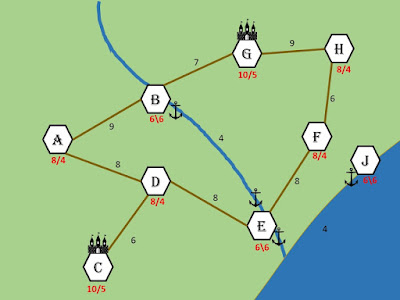 On this map, the hexagons represent campaign locations. The castle symbols represent either cities or fortified areas (the actual symbols used would be based on what time period, and what sorts of locations are important to know about for that time period). The black numbers are the difficult of completing a move along that route. If you decide to try and move an army from location G to location H, for instance, you see that the route has a "9" marked on it. That means, in this simple example, that if you roll 2d6, and score 9 or less, then the move is successful. Sea routes are also marked - notice the score along the river between B and E, and the score along the coast between E and J. The Anchor symbol represents that the location has access to water based movement along the waterway that the anchor is connected to.
So much for movement. But the locations on the map are also marked with pairs of red numbers under each. Those represent two things - the first is the chance to recover troops. This could be a chance to recover lost stands from a unit, after a battle. Again, this is based on a roll of 2d6 or less. The numbers used are purely for example and discussion in this article, but the numbers I used are 8 in regular locations, 10 in population centers (cities), and 6 in ports (or economic centers, but none were marked on this map), where I reasoned that there are more demands for work would mean it is harder to recruit men to serve in a unit. The second number is the chance to recruit a whole unit if it is available to an army to recruit such a unit. Limits could arise from the tactical rules used (i.e. - in some games, and army only consists of a maximum number of units), or could be introduced as part of the campaign (each leader is given an Operations rating, which represents the maximum number of units he may have under his control).
This system could easily be expanded by introducing resources (gold, food, ore, magic, etc) to represent the particular time period. Different types of routes could be introduced (rail lines, which would also have a number representing how difficult it would be to plan a military move over a stretch of rail). By having different routes, different rules on how many different types of moves a unit could make, could be introduced.
That brings me to the last point - action points. I was originally thinking something like 3 action points. It would cost 1 point to move one segment by land, and 1 point to try to recover a lost stand to a unit, but all 3 points to try and recruit a new unit, and maybe 1/2 point to move by a sea route. In this way, if using a 2d6 system to adjudicate actions, then if rolling a 2, one would have a critical success, and would be able to recover an additional action point to use this turn. If rolling a 12, it would mean abysmal failure in planning, and no additional action points may be spent that turn.
Finally, the added element might be characters, or rulers. I always liked the idea, based on the original Tony Bath concept, of having all the major characters in a campaign nation to be developed. This was done in very nice way in the board game Blood Royale, many years ago, and also in many miniatures campaign systems. One of the things by having a dice based campaign system, is that some characters might be better at some actions vs others, not to mention skills at tactical combat (either command bonuses, or combat bonuses). For instance, Lord Whistlebird is a harsh tyrant, but a bit of a coward. He gains a +1 bonus to target numbers when trying to organize a march (he pushes the men into a forced march), but gets no bonus from being in combat with a unit.
Many possibilities are here with even such a simple system. I think I might put together a map, and try it out with the Renaissance troops.
reade more...
Okay, enough philosophy of solo game design. Here is my idea. Have a map, based on point-to-point movement, which is marked up with a number of key pieces of information. Initially, I am thinking that the information would be numbers reflecting the chances of completing a military move, and also of recovering casualties and recruiting new figures. Here is an example of what I am thinking of.
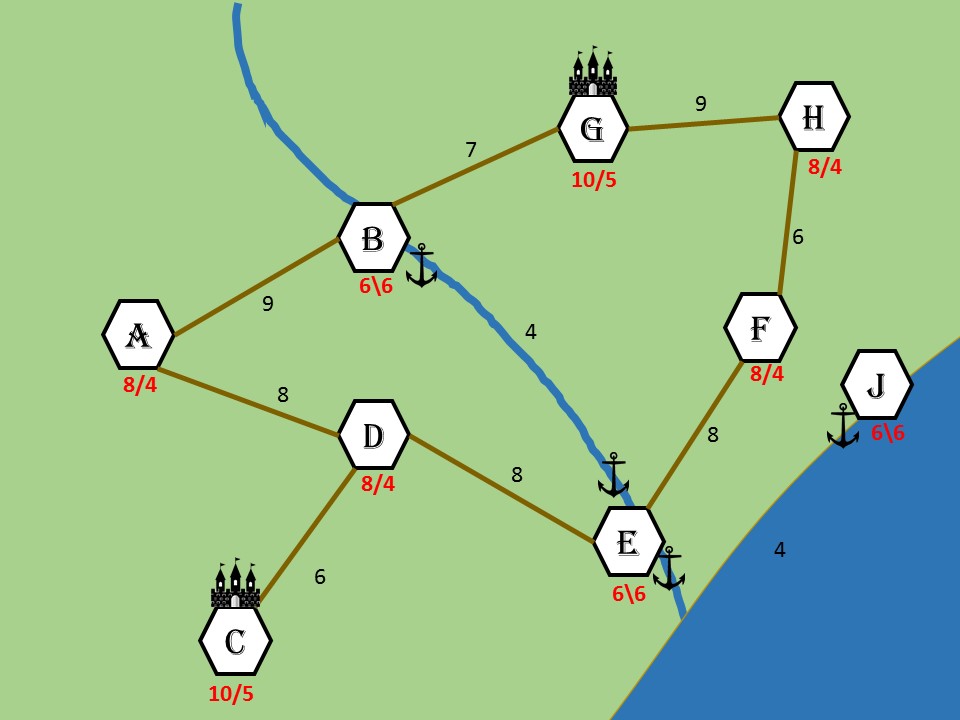
So much for movement. But the locations on the map are also marked with pairs of red numbers under each. Those represent two things - the first is the chance to recover troops. This could be a chance to recover lost stands from a unit, after a battle. Again, this is based on a roll of 2d6 or less. The numbers used are purely for example and discussion in this article, but the numbers I used are 8 in regular locations, 10 in population centers (cities), and 6 in ports (or economic centers, but none were marked on this map), where I reasoned that there are more demands for work would mean it is harder to recruit men to serve in a unit. The second number is the chance to recruit a whole unit if it is available to an army to recruit such a unit. Limits could arise from the tactical rules used (i.e. - in some games, and army only consists of a maximum number of units), or could be introduced as part of the campaign (each leader is given an Operations rating, which represents the maximum number of units he may have under his control).
This system could easily be expanded by introducing resources (gold, food, ore, magic, etc) to represent the particular time period. Different types of routes could be introduced (rail lines, which would also have a number representing how difficult it would be to plan a military move over a stretch of rail). By having different routes, different rules on how many different types of moves a unit could make, could be introduced.
That brings me to the last point - action points. I was originally thinking something like 3 action points. It would cost 1 point to move one segment by land, and 1 point to try to recover a lost stand to a unit, but all 3 points to try and recruit a new unit, and maybe 1/2 point to move by a sea route. In this way, if using a 2d6 system to adjudicate actions, then if rolling a 2, one would have a critical success, and would be able to recover an additional action point to use this turn. If rolling a 12, it would mean abysmal failure in planning, and no additional action points may be spent that turn.
Finally, the added element might be characters, or rulers. I always liked the idea, based on the original Tony Bath concept, of having all the major characters in a campaign nation to be developed. This was done in very nice way in the board game Blood Royale, many years ago, and also in many miniatures campaign systems. One of the things by having a dice based campaign system, is that some characters might be better at some actions vs others, not to mention skills at tactical combat (either command bonuses, or combat bonuses). For instance, Lord Whistlebird is a harsh tyrant, but a bit of a coward. He gains a +1 bonus to target numbers when trying to organize a march (he pushes the men into a forced march), but gets no bonus from being in combat with a unit.
Many possibilities are here with even such a simple system. I think I might put together a map, and try it out with the Renaissance troops.
Italian Wars wargame (pt 2)

In part 1 I talked about the game I set up, along with the army lists. This was a game, set in the 1490s, between a rather generic French force, and a rather generic Italian force. In looking at the history a little closer, and also looking at the units in the armies (from the lists by Neil Thomas, in Wargaming: An Introduction) I think it is fair to say that a good inspiration for the army lists that I settled on could have been representative of the Battle of Fornovo (July 6 1495, near the city of Parma).
 |
| Battle of Fornovo |
The Battle of Fornovo was fought between the forces of Charles VIII (of France) and the Republic of Venice, with help from the Duchy of Milan and the Margravate of Mantua.
In my case, rather than having a river extend between the two armies, I had it run down the table, from the Italian side of the battle field to the French. The battlefield looked something like this:
 |
| The battlefield, using new Terrainguy tiles, purchased from Hal |
The battle opened up, with a turn of maneuver, and then the two battle lines were within artillery range of each other. The French army had two modern (for 1495) pieces of artillery, and the Italians had an older, mid 15th century, bombard. The French artillery was used, to good effect, against one of the units of Italian Gendarmes. The Italian Bombard blew up. Yes, the first time it was attempted to be fired, the Italian bombard exploded.
The Neil Thomas rules play very fast, and since there is no order writing, or maneuver planning, it is pretty well suited for solo play. With the very simple army list and troop type structure, and no points values, I don't think it would make for a great basis for a solo campaign.
 |
| The Swiss Pike - 2 units, 6 stands each |
 |
| The Italian Shot, armed with crossbow, inbetween the swordsmen and the Italian pike |
 | |
| French cavalry, to left, encounter Italian Gendarmes. Swiss Pike, at bottom, still approaching |
 |
| Mercenary Italian Crossbowman, in French Service |
 |
| French Gendarmes encounter Italian Swordsmen |
 |
| Used as French Mounted Archers, without their bows |
 |
| Mercenary Crossbow preparing to cross the river |
In the picture above, you can see some of the terrain elements I used. Of course, I used felt for the road, which is always serviceable. I used my commercial river, which looked good on the tile surface. I also used a painted bridge and villa, both in resin originally. And woodland scenics trees, mounted on fender washers. The hills are beadboard, with paint and grass applied. I did not make the hills, but I do have a series in the works - they are awaiting final finishing, and I hope to feature them in a game later on this spring or summer.
 |
| Mounted Crossbow in the Italian army |
During the game, I only had painted one unit of mounted crossbow available, and the Italian army called for two. The army also had a unit of foot crossbow, so I made the decision to dismount one of the mounted crossbow units, and field it (for the battle) as a foot unit. I actually have (recently dug out, and based for priming) enough Minifigs mounted crossbow (in the 15mm Renaissance line) to complete a unit. Pictures to follow, as they get completed.
 |
| I use nylon upholstery rings for casualty markers |
Stands come right off the unit. The rules allow for mixed units (halberd/bow, and pike/shot, for instance). The rules are, when a unit loses a stand in melee combat it is always either a pike or halberd stand. When it loses a stand from fire combat, it is always either a bow or shot stand. When you lose a stand to shooting, that is all. But when you lose a stand to Melee combat, then you have to pass a morale test (the only morale tests in the game) - for instance, Levy troops require a 5 or 6 on a D6 roll. No such rolls are required for losing a stand to Fire combat.
 |
| French Gendarmes ride past an Italian Villa |
 |
| The Italian Condottieri leading the Gendarmes |
 |
| Charles VIII Enter |
 |
| The Situation in Italy |
 |
| Great images of soldiery from the time, in this set of German prints showing city flags and heraldry. |